If your home was built before 1990 and you've never had your attic assessed, there is a better than 9-in-10 chance your insulation is underperforming right now. That's not a scare tactic — it's what the EPA reports nationally, and it tracks almost exactly with what our technicians find when they get up there with a measuring tape in homes across this area.
This page gives you the exact warning signs to watch for, a simple self-assessment you can do in 15 minutes, and a clear picture of what adequate attic insulation actually looks like in a Central Florida home — helping you confidently plan for top insulation installation near Altamonte Springs FL before spending a dollar on anything.
TL;DR Quick Answers
Top Insulation Installation Near Altamonte Springs FL
Altamonte Springs sits in DOE Climate Zone 2. Here's what matters most:
Target R-value: R-49 to R-60. R-38 is code minimum — not the goal.
Best material: Blown-in fiberglass for most homes. Closed-cell spray foam when ductwork runs through the attic.
Typical cost: $1,500 to $3,000 before incentives.
Available incentives: Duke Energy Florida rebate up to $800 + federal 25C tax credit up to $1,200 = up to $2,000 combined offset.
Most important step: Complete the Duke Energy Home Energy Check before scheduling installation. Both incentives require it or a certified auditor — and neither can be claimed after the fact.
Why it matters here: Florida homes spend 27% of their energy budget on AC — more than four times the national average. 9 in 10 homes are under-insulated. In Altamonte Springs, the attic is almost always where the comfort and efficiency problem starts.
Who to call: Filterbuy HVAC Solutions serves ZIP codes 32701, 32714, 32716, and 32751 across the Altamonte Springs area with licensed, code-compliant attic insulation installation and free quotes.
Top Takeaways
R-38 is the floor, not the target. Altamonte Springs sits in DOE Climate Zone 2. Minimum is R-38. Sweet spot is R-49 to R-60. Most homes we assess are nowhere near either number.
9 out of 10 homes are under-insulated — and Florida's energy stakes are 4x higher. National AC energy average: 6% of home energy use. Florida's: 27%. An under-insulated attic costs money everywhere. Here, it costs money every month of the year.
The attic is almost always the problem — not the equipment. Properly sized AC systems get replaced twice in ten years because no one looked up. Fix the attic first. Every HVAC investment that follows performs better because of it.
Up to $2,000 in incentives is available — but only if you move in the right order.
Duke Energy Florida rebate: up to $800 — requires a Home Energy Check before installation.
Federal 25C tax credit: 30% back, up to $1,200 — requires a certified auditor.
Both can be combined. Neither can be claimed retroactively.
In Central Florida, proper insulation is a mechanical necessity — not an optional upgrade. AC season runs March through November. There is no recovery window. Every month under-insulated means higher bills, faster equipment wear, and comfort your family shouldn't have to compromise on.
Why Attic Insulation Fails Faster in Altamonte Springs Than Most of the Country
Attic insulation doesn't last forever — and in Florida's climate, it degrades faster than homeowners expect. Heat, humidity, and the constant thermal cycling of a Central Florida attic accelerate the compression and deterioration of insulation materials over time.
What compounds the problem here specifically:
Attic temperatures in Altamonte Springs regularly exceed 150°F in summer
High humidity creates moisture conditions that degrade certain insulation types faster than dry climates
Older blown-in insulation settles and compresses over time — reducing its effective R-value significantly below its original rating
HVAC ductwork running through the attic adds additional heat load that accelerates wear on surrounding insulation
The result is a home that worked fine 15 years ago and now can't stay comfortable no matter what the thermostat says, which is where attic insulation installation services can make a meaningful difference.
The 5 Warning Signs Your Altamonte Springs Attic Needs More Insulation
These are the signs we see most consistently in under-insulated homes across this area:
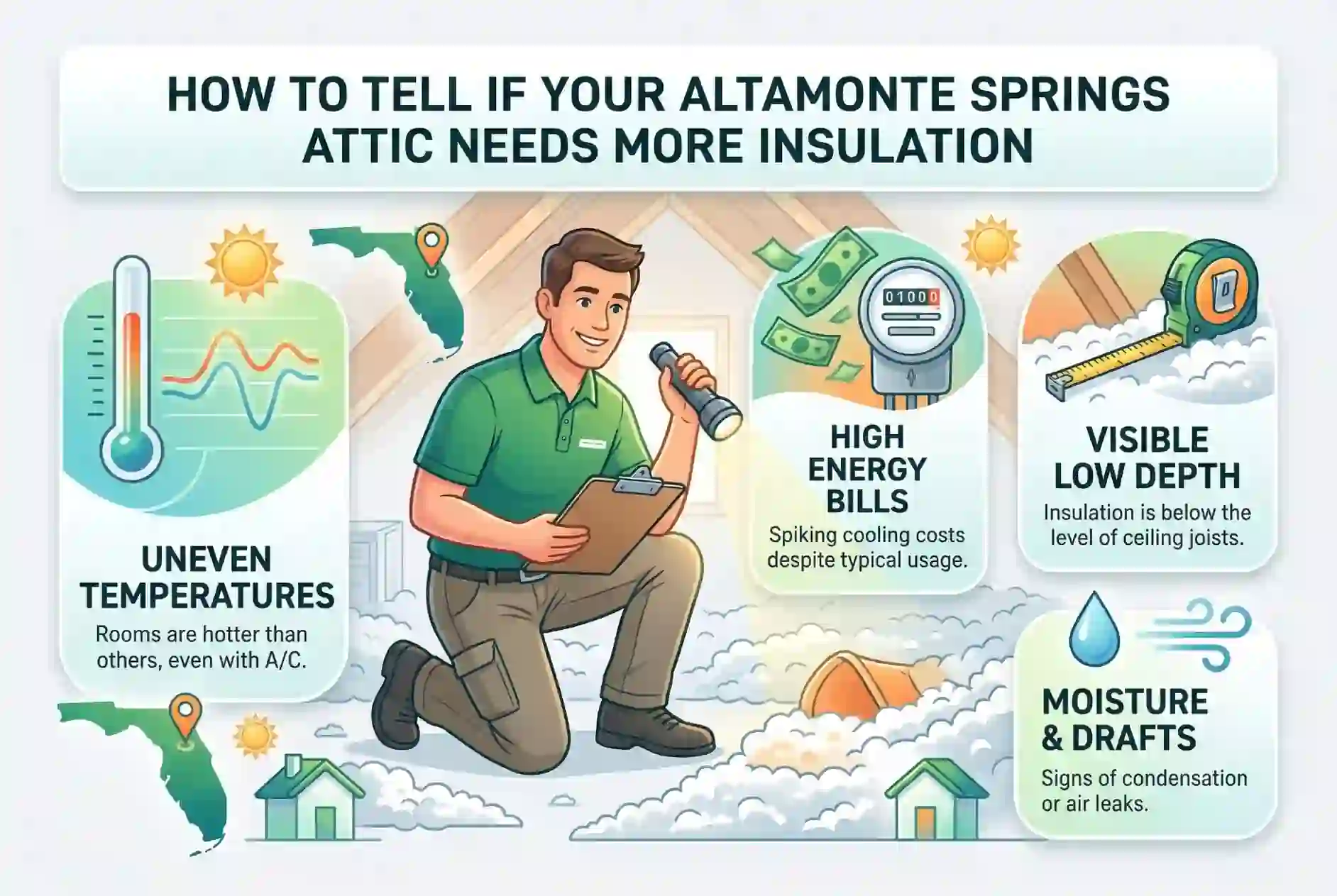
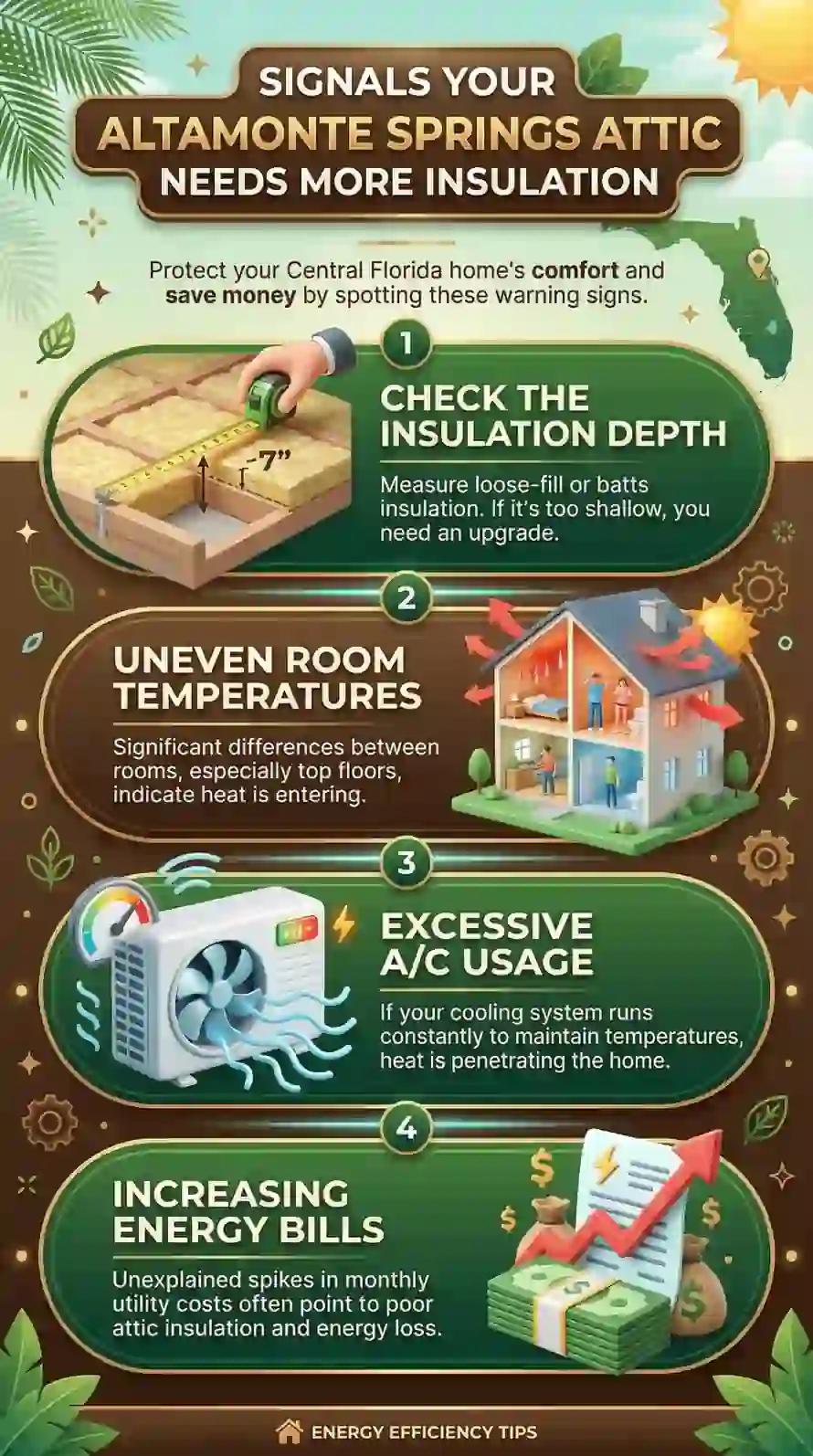
Uneven room temperatures. Some rooms cool easily. Others never quite get there. When insulation is insufficient or unevenly distributed, heat transfers inconsistently through the ceiling — forcing your HVAC system to work harder to compensate.
An AC system that runs constantly. If your system never seems to reach the set temperature — especially during peak afternoon heat — your attic is likely the cause. A 150°F attic pushing heat through an under-insulated ceiling overwhelms even a properly sized, well-maintained system.
Energy bills that keep climbing. Rising cooling costs without a change in usage habits or equipment are one of the clearest indicators of insulation degradation. We've walked into homes where the utility bills told the story before we even looked in the attic.
Rooms that feel humid indoors. Inadequate attic insulation allows heat and moisture to infiltrate your living space more freely. If certain rooms feel sticky or humid despite your AC running, compromised attic insulation is a common contributing factor.
An HVAC system that's aging faster than it should. Premature AC failure is one of the most expensive consequences of a chronically under-insulated attic. A system forced to overwork for years wears out components faster. In many cases, the unit gets replaced when the attic should have been addressed first.
How to Check Your Attic Insulation Yourself
You don't need a professional to get a baseline picture. Here's a simple 15-minute self-assessment:
What you need:
A flashlight
A measuring tape or ruler
A smartphone to take photos
What to do:
Access your attic through the hatch or pull-down stairs
Look across the attic floor — if you can see the tops of your floor joists, you need more insulation
Measure the depth of your insulation in several spots across the attic floor
Multiply your measurement in inches by 3 to estimate your current R-value (blown-in fiberglass runs approximately R-3 per inch)
Check for coverage gaps near eaves, around recessed lights, and at the attic hatch — these are the most common weak points we find
Look for signs of moisture, staining, or compression — all indicators of insulation that is no longer performing at its rated value
What the numbers mean for Altamonte Springs:
Less than 10 inches of depth: significantly under-insulated for Climate Zone 2
10 to 13 inches: at or near R-38 code minimum — functional but not optimal
16 inches or more: approaching R-49 to R-60 — where real comfort and savings begin
The Areas Most Likely to Be Under-Insulated in Your Home
After assessing attics across Central Florida, these are the spots where we consistently find the biggest gaps:
Near the eaves. Insulation thins out toward the edges of the attic floor in most older homes — often to the point of being nearly absent at the perimeter.
Around recessed can lights. Can lights that penetrate the ceiling create gaps that allow both heat transfer and air leakage. This is one of the most common and most underestimated problem areas we find.
At the attic hatch. The access point to your attic is frequently uninsulated or minimally insulated — a small gap that creates a disproportionate amount of heat infiltration.
Over additions and extensions. Rooms added to the home after original construction often have attic spaces that were never properly insulated to match the rest of the home.
When to Stop DIY-ing and Call a Professional
A self-assessment gives you a useful starting point. But there are situations where professional evaluation is the right next step:
Your insulation measures below R-19 anywhere in the attic
You find moisture, mold, or water staining in the insulation
Your ductwork runs through the attic and you suspect leaks
Your home is older than 1978 and the insulation has never been professionally assessed
You've noticed uneven cooling that persists even after your AC system has been serviced
The attic is the single highest-impact area of your home when it comes to energy efficiency in Altamonte Springs' climate. A professional assessment takes 15 minutes, costs nothing upfront, and gives you a clear, specific picture of what your home actually needs — making professional attic insulation installation services a smart step toward improving comfort, reducing energy loss, and optimizing your home's efficiency.
"Every week we assess attics in Altamonte Springs homes where the homeowner has already replaced their AC system once — sometimes twice — without anyone ever looking up. The unit wasn't the problem. It was never the unit. When a properly sized system can't keep a Florida home cool, the attic is the first place we go. Nine times out of ten, it's also the last place we need to look."
Essential Resources
We share these resources with every homeowner we work with in Altamonte Springs. Read them before you call anyone — including us. The more you know going in, the better every conversation goes.
1. Know Your Target: ENERGY STAR Recommended Home Insulation R-Values
Altamonte Springs sits in DOE Climate Zone 2. That means you need between R-38 and R-60 in your attic. This page shows you exactly what that looks like — and why the number matters before you accept a single quote.
2. Check Before You Call: How to Measure Your Attic Insulation Level
Grab a flashlight and a tape measure. This ENERGY STAR guide walks you through a 15-minute self-check. You'll know your starting point before anyone sets foot in your attic — and that protects you from inflated assessments.
https://www.energystar.gov/products/ask-the-experts/how-check-your-homes-attic-insulation-level
3. Get a Professional Assessment: DOE Guide to Home Energy Assessments
A certified home energy auditor finds what a visual inspection can't — including duct leaks and air sealing gaps. This DOE guide explains what to expect and how to find a qualified assessor near Altamonte Springs. It's also required if you want to qualify for the federal 25C tax credit.
https://www.energy.gov/energysaver/professional-home-energy-assessments
4. Capture Your Federal Tax Credit: IRS Section 25C Energy Efficient Home Improvement Credit
Most homeowners we talk to don't know this credit exists until the project is already done. Qualifying attic insulation upgrades are eligible for 30% back — up to $1,200. Read the eligibility requirements here before installation begins. You can't apply retroactively.
https://www.irs.gov/credits-deductions/energy-efficient-home-improvement-credit
5. Stack Your Savings: Duke Energy Florida Attic Insulation Rebate
Duke Energy Florida offers up to $800 back on qualifying attic insulation projects. Combined with the federal tax credit, that's up to $2,000 in potential savings. The catch: you have to complete a Home Energy Check first. Don't skip this step.
https://www.duke-energy.com/home/products/home-energy-improvement/attic-insulation-upgrade?jur=FL01
6. Protect Against Florida's Biggest Hidden Risk: EPA Guide to Mold and Moisture
In Altamonte Springs, humidity isn't a seasonal issue — it's year-round. Insulation that isn't right for Florida's climate doesn't just underperform. It can trap moisture and create conditions for mold growth behind walls and in attic cavities. This EPA guide is essential reading before any insulation project in Central Florida.
https://www.epa.gov/mold/brief-guide-mold-moisture-and-your-home
7. Verify Your Contractor Is Working to Current Code: Florida Building Code Energy Conservation 2023
This is the current legal standard every licensed contractor must meet in Seminole County. Not every contractor pulls permits or works to current code. Knowing what the 2023 standard requires means you can verify the work — not just trust it.
https://www.seminolecountyfl.gov/docs/default-source/pdf/FormR402-2023ada.pdf
Work through these in order. R-value target first. Current insulation level second. Incentives third. Homeowners who do this consistently get better results — and keep more money in their pocket.
Supporting Statistics
After assessing hundreds of homes across Central Florida, the same pattern repeats. Uneven cooling. Rising bills. An AC that never shuts off. We go into the attic. The insulation is thin, compressed, or nearly gone. The data backs up exactly what we see in the field — every time.
Stat 1: 9 out of 10 U.S. homes are under-insulated — and most homeowners have no idea.
Not 1 in 10. Not half. Nine out of ten.
In our experience across Altamonte Springs neighborhoods, that number tracks exactly.
Attics are invisible by design. Problems don't announce themselves until the energy bill does.
The EPA confirms it through ENERGY STAR data. We confirm it every week through what we find when we open the hatch.
Source: ENERGY STAR, U.S. Environmental Protection Agency https://www.energystar.gov/saveathome/seal_insulate/why-seal-and-insulate
Stat 2: Proper attic insulation cuts heating and cooling costs by an average of 15% — and in Florida, that number works harder.
The EPA's 15% figure is based on national averages.
It doesn't capture what happens when you run AC nine to ten months a year instead of three or four.
We've seen Altamonte Springs homeowners cut monthly bills beyond that figure after a proper insulation upgrade.
Every degree of heat transfer you prevent in July is money you keep — not money sent to the utility company.
The national average undersells what this upgrade actually delivers here.
Source: ENERGY STAR / EPA, Rule Your Attic https://www.energystar.gov/saveathome/seal_insulate/rule_your_attic
Stat 3: Florida households spend more than 27% of their home energy budget on air conditioning — over four times the national average.
National average for AC's share of home energy use: ~6%.
Florida's share: 27%.
That gap isn't just climate. It's the direct cost of homes not built or updated for what Central Florida's heat actually demands.
An under-insulated attic in Ohio costs you three months of inefficiency. Here, it costs you all year.
Source: U.S. Energy Information Administration, Household Energy Use in Florida https://www.eia.gov/consumption/residential/reports/2009/state_briefs/pdf/fl.pdf
Stat 4: 96% of Florida households run air conditioning — the highest rate in the nation.
Every home we walk into in Altamonte Springs runs an AC system. That's not a coincidence — it's a necessity.
Florida doesn't just lead nationally on AC dependency. It leads by a wide margin.
An under-insulated attic means that the system works harder, runs longer, and ages faster.
You're not just wasting energy. You're shortening the life of equipment you've already paid for.
Source: U.S. Energy Information Administration, Residential Energy Consumption Survey (RECS) https://www.eia.gov/consumption/residential/
These statistics show why many Altamonte Springs homeowners choose to invest in top insulation installation to reduce energy loss, improve indoor comfort, lower cooling costs, and help their HVAC systems operate more efficiently in Central Florida’s demanding climate.
Final Thought
Most home improvements have a clear before and after. New floors look better. Fresh paint is immediately visible. A new AC unit hums to life and you feel it within minutes.
Attic insulation doesn't work that way. You don't see it. You don't hear it. The improvement is invisible — and that's exactly why it gets skipped, delayed, and forgotten.
Here's our honest take after years of assessments across Altamonte Springs homes.
The attic is the most consistently overlooked, highest-impact upgrade in Central Florida — and that gap costs homeowners real money every month.
We've walked into homes where the AC was replaced twice in ten years. Correct sizing. Professional installation. And the house still wouldn't cool properly.
Every time, the attic told the same story:
Insulation compressed to a fraction of its original depth
R-values well below Climate Zone 2 minimums
Heat pouring through the ceiling as fast as the AC could remove it
Gaps, moisture damage, or material untouched since the home was built
The equipment wasn't failing. It was fighting physics — and losing.
Our opinion: in Altamonte Springs, attic insulation isn't a comfort upgrade. It's a mechanical necessity.
Florida's climate doesn't give HVAC systems a recovery window. In most of the country, a system can absorb the cost of an under-insulated attic during mild months. Here, there are no mild months. The attic is under thermal stress from March through November.
What we see consistently:
Homeowners who address the attic first get more out of every other HVAC investment they make.
Homeowners who skip it keep chasing the same symptoms — uneven temperatures, high bills, premature equipment failure — without fixing the cause.
The EPA's 15% energy savings figure is real. In our experience serving Central Florida homes, it's often conservative.
The decision most Altamonte Springs homeowners are actually facing isn't whether to insulate. It's whether to keep paying for the consequences of not insulating.
The R-value targets, the materials, the incentives, the contractor standards — all of it becomes straightforward once you understand what's happening above your ceiling.
Making the invisible visible changes everything. The attic you never think about has more influence over your comfort, your energy bills, and your HVAC system's lifespan than almost any other part of your home.
That's what years of work in these homes has taught us. The attic is always the first place we look — because it's almost always where we find the answer.
FAQ on Top Insulation Installation Near Altamonte Springs FL
Q: How do I know if my Altamonte Springs home needs new attic insulation?
A: The attic is rarely the first place homeowners look — but it's almost always where we find the answer.
Warning signs to watch for:
AC runs constantly but never reaches the thermostat setting
Uneven temperatures room to room or floor to floor
Energy bills climbing with no change in usage
Indoor humidity feels stubborn despite AC running
HVAC equipment failing sooner than expected
Quick self-check:
Grab a flashlight and tape measure
Insulation at or below floor joists — or less than 10 inches deep — means you're under-insulated
Pre-1990 homes are highest risk
After hundreds of assessments across Altamonte Springs: 9 in 10 homes without a recent assessment don't have enough insulation.
Q: What R-value do I need for my attic in Altamonte Springs?
A: Altamonte Springs is in DOE Climate Zone 2. Here's what that means:
R-38: Code minimum — the floor, not the goal
R-49: Where most homeowners actually feel the difference
R-60: Best for older homes or attics with duct systems running through them
What we see constantly in the field:
Insulation that looks intact from the hatch
Compressed and moisture-degraded underneath
R-values well below code despite appearing fine
Florida's humidity degrades insulation faster than most homeowners realize. Measuring depth is the only way to know for certain.
Q: What type of attic insulation works best in Altamonte Springs' climate?
A: Florida's heat and humidity narrow the options quickly. Here's how they stack up from what we see in Central Florida homes:
Blown-in fiberglass: Most recommended. Moisture-resistant. Covers gaps evenly. Installs precise R-value targets.
Closed-cell spray foam: Best when ductwork runs through the attic. Acts as insulation and vapor barrier in one. Higher upfront cost, strongest long-term performance.
Blown-in cellulose: Good R-value per inch. Requires careful installation in humid climates to avoid moisture retention.
Fiberglass batts: Common in older homes. Rarely sufficient alone in Florida. Almost always needs supplementing.
What we find most often — regardless of material:
Gaps in coverage
Compressed insulation
Uneven depth across the attic floor
The material matters less than the installation quality.
Q: How much does attic insulation installation cost in Altamonte Springs — and what incentives are available?
A: Most projects run $1,500 to $3,000 depending on attic size, current levels, and material choice.
Available incentives — and the required order:
Complete the Duke Energy Florida Home Energy Check first — required before installation to qualify for the rebate
Schedule installation — with a certified contractor working to current Florida Building Code
Claim the Duke Energy Florida rebate — up to $800 on qualifying projects
Claim the Federal 25C tax credit — 30% back, up to $1,200, requires a certified auditor
Combined potential offset: up to $2,000
Critical note: Neither incentive can be claimed retroactively. We've seen homeowners lose both by scheduling installation before completing the required steps. Order of operations is everything.
Q: How long does attic insulation installation take in Altamonte Springs?
A: Most projects finish in a single day.
Here's what the process looks like:
Inspection — Current depth measured, material condition assessed, moisture and air sealing issues identified before work begins
Preparation — Ventilation confirmed, surrounding areas protected, space readied for installation
Installation — Insulation brought to code-compliant R-value targets using the right material for the attic's specific conditions
Final check and cleanup — Coverage verified, R-value documentation provided, space left clean
When projects take longer:
Removal of damaged or degraded insulation may add a second day
Moisture or mold found during inspection requires remediation before new insulation goes in
In older Altamonte Springs homes, this happens more often than homeowners expect
Remediation isn't a complication. It's the step that protects everything installed after it.
If you’re evaluating comfort issues in your home, the article How to Tell If Your Altamonte Springs Attic Needs More Insulation explains that insulation problems often appear alongside HVAC performance issues such as uneven temperatures, excessive AC runtime, or rising energy bills. While improving attic insulation reduces heat transfer, maintaining proper airflow and filtration is equally important for overall indoor air quality and system efficiency. Using the right filters, such as the 20x25x4 MERV 8 air filter, helps capture dust and airborne particles before they circulate through your home. Larger system filters like the 20x25x5 HVAC furnace air filter can further support cleaner airflow while your insulation upgrade improves thermal performance. For homeowners comparing additional compatible options, the Trane compatible MERV 11 air filter illustrates how selecting the correct filter size and efficiency rating complements attic insulation improvements, helping your HVAC system run more efficiently and keeping your Altamonte Springs home comfortable year-round.